The Last Breath of the Wild: Where Alpine Peaks and Ocean Depths Reveal Earth’s Fragile Majesty
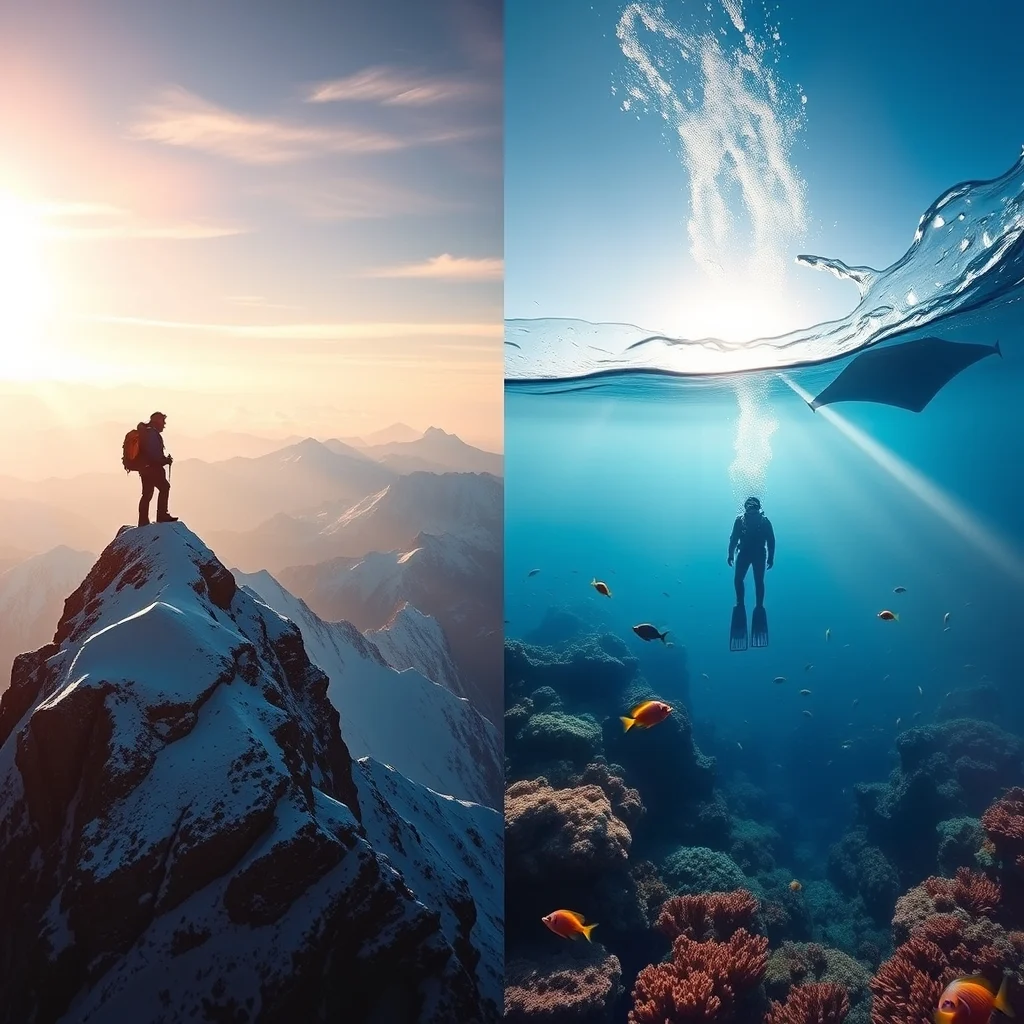
The wind howls across the ridge, a relentless force that carries the scent of ice and distant pine. It tugs at the edges of your jacket, whispering secrets of the heights you’ve climbed, the air thinning with every step until your lungs burn with the effort of drawing life from the sky. This is the realm of the alpine—the domain of jagged spires and snowfields that stretch like frozen rivers into the horizon. Here, the world feels both vast and intimate, a place where the earth’s raw power is laid bare, and every breath is a testament to the sheer will it takes to stand at the edge of the possible. But the mountains are not the only cathedrals of the wild. Beneath the surface of the sea, another world pulses with equal majesty, where light fractures into a thousand hues as it filters through the water, illuminating the silent ballet of coral and fish. These are the blue spaces, the last great frontiers where adventure and awe collide, and where the fragile beauty of our planet is both revealed and threatened.
The Ascent: A Dance with the Sky
There is something primal about climbing—a dance between human tenacity and the unyielding force of stone and ice. The first time you clip into a rope, the cold bite of a carabiner against your palm, the way your fingers numb as you grip the rock, you understand that this is more than a physical challenge. It is a conversation with the earth itself. The mountains do not care for your plans or your fears. They demand respect, patience, and humility. And when you finally stand on that summit, the world unfolding beneath you in a patchwork of valleys and rivers, the wind carrying the distant cry of an eagle, you feel it—the quiet, electric thrill of having touched the sky. But the ascent is only half the story. The real magic lies in the descent, in the way your body remembers the rhythm of each step, the way your mind replays the moments of doubt and triumph as if they were scenes from a dream.
Alpine climbing is not just about reaching the top; it is about understanding the language of the peaks. The way the snow creaks under your boots, the way the ice groans as it shifts beneath your crampons, the way the clouds roll in like a living thing, swallowing the landscape whole. These are the moments that etch themselves into your soul, the ones that remind you of your place in the grand tapestry of the wild. And yet, for all its raw beauty, the alpine world is fragile. The glaciers are retreating, the snowlines rising, and the delicate ecosystems that cling to these heights are under siege. To climb is to bear witness—to see firsthand the changes wrought by a warming planet, and to carry the weight of that knowledge with you long after you’ve descended.
The Descent into the Deep: A World Unseen
If the mountains are the earth’s spine, then the ocean is its lifeblood—a vast, shifting expanse that covers more than seventy percent of the planet. To dive beneath its surface is to enter a realm where time moves differently, where gravity loses its grip, and where the rules of the terrestrial world no longer apply. The first breath through a regulator is a revelation, a sudden awareness of the weight of the water pressing in from all sides. And then, as your eyes adjust to the dim light, the world unfolds in a riot of color and movement. Coral towers rise like ancient citadels, their branches swaying in the current, while schools of fish dart between the crevices like living jewels. This is the coral cathedral, a place of quiet reverence where every creature, from the tiniest nudibranch to the majestic manta ray, plays a role in the delicate balance of life.
But the ocean is not just a playground for adventurers; it is a battleground. Coral reefs, those vibrant underwater rainforests, are dying at an alarming rate. Rising sea temperatures, ocean acidification, and the relentless pressure of human activity are pushing these ecosystems to the brink. To dive is to see the evidence of this crisis firsthand—the bleached skeletons of once-thriving corals, the ghostly silence of reefs that have lost their song. And yet, even in the face of such devastation, there is hope. Marine conservation efforts are gaining momentum, with scientists, divers, and local communities coming together to protect and restore these vital habitats. The ocean is resilient, but it needs our help. Every dive is an opportunity to bear witness, to learn, and to advocate for the wild places that sustain us all.
The Thread That Binds: Adventure as a Force for Change
Adventure is often seen as an escape—a way to leave the noise of the modern world behind and lose yourself in the untamed beauty of nature. But what if adventure could be more than that? What if it could be a catalyst for change, a way to reconnect not just with the wild, but with our own humanity? The mountains and the sea have a way of stripping away the distractions, of forcing us to confront the truth of our place in the world. They remind us that we are not separate from nature, but a part of it—that our actions have consequences, and that the choices we make today will shape the world of tomorrow. Sustainable tourism is not just a buzzword; it is a lifeline for the wild places we cherish. It is about treading lightly, leaving no trace, and giving back more than we take. It is about supporting local communities, protecting endangered species, and advocating for policies that prioritize the health of the planet over profit.
When you stand on a summit or descend into the depths, you are not just an observer; you are a participant in something far greater than yourself. The peaks and the ocean do not belong to us—they are not ours to conquer or exploit. They are gifts, fragile and fleeting, and it is our responsibility to protect them. The next time you clip into a rope or slip beneath the waves, remember that you are not just seeking adventure; you are answering a call. A call to witness, to preserve, and to ensure that the wild places of this earth remain for generations to come. The wind will always howl across the ridge, and the tides will always rise and fall, but it is up to us to ensure that the magic of these places endures. The last breath of the wild is not a whisper fading into silence—it is a roar, a call to action, a reminder that the earth’s fragile majesty is worth fighting for.